Monday, July 20, 2009

1905 to 1910 Mining in Cobalt


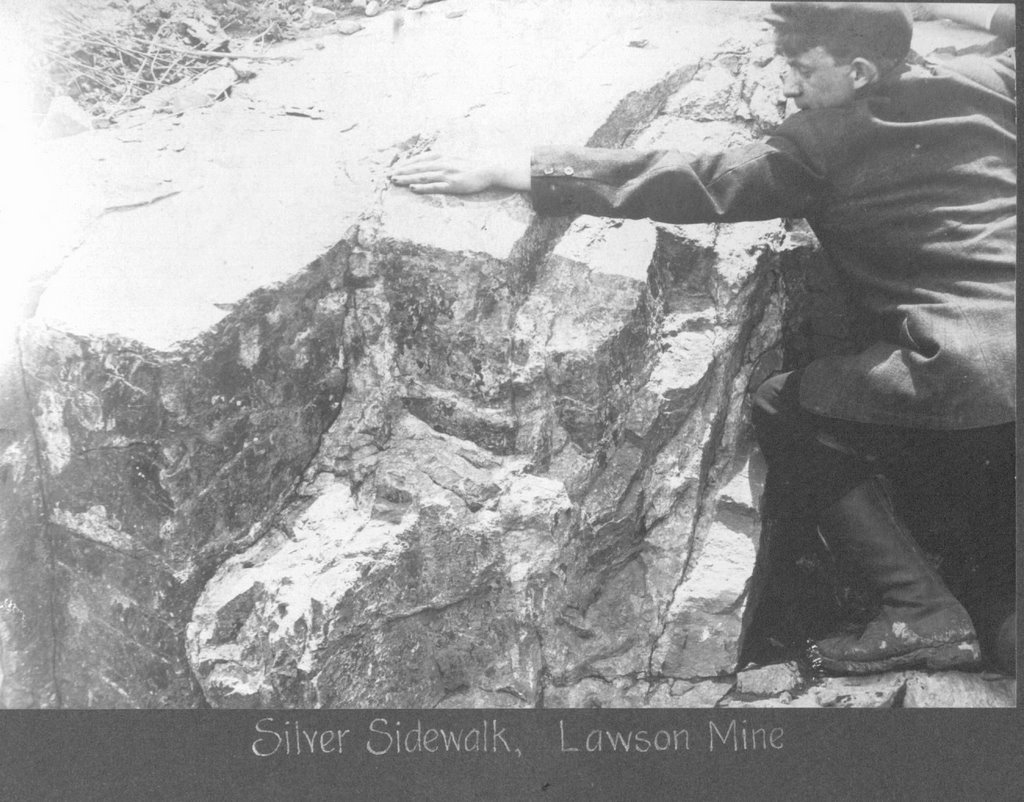
Silver Sidewalk Lawson Mine
As I mentioned early Charles Taylor was an avid amateur photographer who, during his travels, recorded the history of his time. While being an amateur at the art Charles excelled in his knowledge of the camera and its limited ability.

Many of these photo's are not only rare in their subject matter but they are rare in their technical sense as well.


Surface vein at the Lawson Mine

Surface Vein


Drilling at La Rose Mine


Mucking at La Rose

Underground Vein at La Rose


La Rose Vein

1910 to 1914 The Pre-war Years.


Experience with the earlier compressors had led to an improvement in design and efficiency. The Ragged Chutes Air Plant ran at 82% efficiency.

There are several inherent advantages to this system. The air is drier than that obtained from mechanical compressors because of its close proximaty to cold water. It does not contain the oil and fumes associated with mechanical compressors. The initial cost is about equal to that of other compressors however operating costs are almost nil. In its day the rates charged were 25 cents per 1000 cu. ft. This was substantially less than other air companies in the area. As a result, Cobalt Power was able to buy out the others.

The Cobalt plant has worked almost continuously since 1910. In 1950 the plant was shut down to overhaul the intake pipes. 86 tubes were repalced due to corrosion. Again in 1961 the tunnel was dewatered to facilitate some repairs to the air pipe. This in itself is truly remarkable and pays tribute to Taylor's inventive genius and design skills.

Within a few short years Taylor had disagreements with his financial backers over operating policies so he resigned and left the business. The plant was later sold to the Northern Ontario Power Company.

Ontario Hydro now owns the plant, which has since been destroyed by fire, and has no plans to rebuild it at this time. No more plants can be built privately today, as the waterways are now controlled by the government. ( * Special note: The plant has since been destroyed by fire. All that remains are the tubes)

During the 1930's, the Tennesseee Valley Authority, using Taylor plans, built a 50,000 H.P. plant. One of the designers misread a measurement by a decimal point and plant efficiency was reduced to 10%. This illustrates how accurate the original Taylor design had been.
Cobalt - The Days of Construction


The accomplishments of our ancestors is made even more amazing when we stop to look at the conditions in which they worked and the tools at hand. We have to remember that these men were without benefit of mobile cranes but rather constructed dericks with which to hoist heavy materials. Calculations were done without the benefit of calculators, never mind computers. Engineers and architects worked with quill or nib pens. They dipped the pen in an ink well and drew a section of a line then dipped the pen and continued the line drawing.

Transportation of materials would have been by rail, but first they had to build the spur line. Special riggings with horse and harness would be the mode of transportation to site locations. Trees had to be cleared with two man buck saws to make way for roads and right of ways.


Building Cordoroy Road


Anchor Pier and Gate Valve, 20" Pipe Line

Company Bunk House

Cobalt - Construction cont'd


Workers in the mines and on the construction sites at the turn of the 20th century were a hardy bunch who made do with what they had. Much of their clothing and household goods would have been ordered from the Eaton's Mail Order News advertisements in the Cobalt Daily Nugget.
Water Wheel at power house
Spillway camp #5
Panoramic view Camp #5
Lumber Camp
Hound Chutes Gate Pier
Hound Chutes Canal
Hound Chutes Boat Landing
Hound Chutes Shaft
Hound Chutes Form for Powerhouse
Hoistrunners Family and Cabin
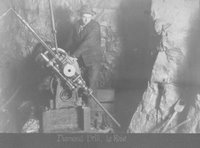
Diamond Drill at Work
Chapman's Camp
Company Mail Team
Camp #5 from #3 Shaft


1905 to 1910 More than a Mining Town

In its early years Cobalt was more than just mines and shanties. It was a vibrant hussling and bussling community with an Opera House, a Masonic Temple, a Hotel and much more.

Cobalt Looking South


The Opera House Block

Town Hall and Masonic Temple

Prospct Hotel

Catholic Church

Canadian Bank of Commerce

The Square Cobalt


Trenching on Nippissing Hill

Relaxation time in Early cobalt


Life in early Cobalt was not all work as can be seen in the accompanying photo's. For those of you who have have been a part of this historic area all your lives you may find one or two of you ancestors here. Unfortunately I don't have all the names however, those I do have are posted with the photo.

Enjoy......


Hunting, breaking camp
Mr. and Mrs Moulinard and Mrs. Rogers
Midnight Duck Supper
Mr Cairnie and Miss
Spencer
Partridge Hunting, One Last Shot


Paul, Mr. Benedict and Mrs. Symmes


Saturday Night Poker

Cobalt and Old Victoria sketches


Cobalt Sketch


OLD VICTORIA


Other Plants:
A 200 h.p. plant in the State of Washington has a working head of 45 ft., an induction column 260 ft. long 3 foot diameter, which compresses the air to 85 lbs. per sq. in. Water flows through the plant at the rate of 53 cu. ft. per second.


A hydraulic compressor was installed in Germany in 1907-08 at Clausthal, having a head of 325 ft. and an average flow of 792 gallons per minute. The efficiency was calculated to be 73.6%.


A large plant was installed at Norwich, Connecticut for general power purposes.
At Tarica, Peru South America a plant was installed utilizing a working head of 69 ft. The design is somewaht similar to that at Kootenay where a tower was used to supply the working head.

Peterborough Lock


When the Ainsworth BC plant failed to reach its financial expectations Taylor paid back the investors the tidy sum of $60,000 from his own pocket. ( see Sketches and Links for alternate story)

This put quite a finacial strain on the company however in 1898 Taylor received an order from the Dominion Government to supply and install a 45 horse power compressor at the Peterborough Lift Lock on the Trent Canal in Ontario.

Here we see the underside of the lift taken in modern times. Below is a photo taken at the top of the locks showing the spectacular view that boaters have enjoyed for over 100 years.


Here at the bttom is a photo of Taylor (middle) at the Peterborogh site during construction.

The photo below is the manhole cover at the locks indicating the company manufacturer.